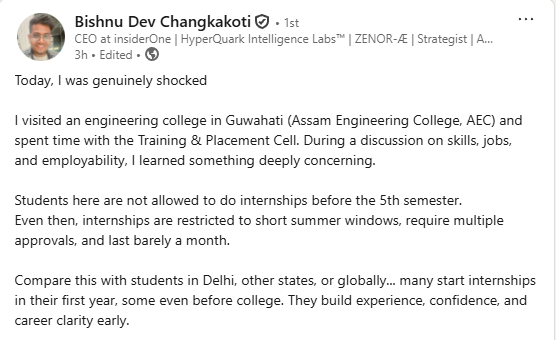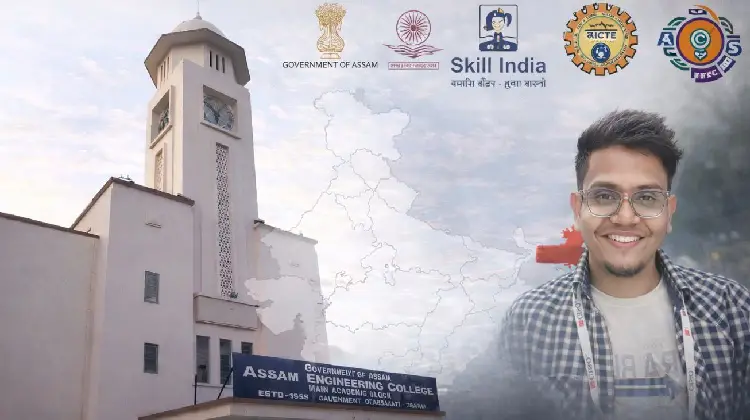

Guwahati: A LinkedIn post by entrepreneur Bishnu Dev Changkakoti has sparked renewed discussion around internship policies in Assam’s engineering colleges, drawing attention to what he describes as outdated academic rules that may be limiting students’ employability and early industry exposure.
Changkakoti, who recently visited Assam Engineering College in Guwahati and interacted with its Training and Placement Cell, wrote that students are not permitted to take up internships before the fifth semester. Even after that stage, he noted, internships are largely confined to short summer windows, require multiple institutional approvals, and often last no more than a month.

“In many other states and globally, students begin internships in their first year, sometimes even before formally entering college,” Changkakoti wrote. “They build experience, confidence, and career clarity early. Here, students are capable and motivated but the rules don’t allow them.”
According to education and industry observers, early internships have increasingly become a critical component of workforce readiness, particularly in engineering and technology fields where employers place high value on practical exposure alongside academic performance.
A policy gap, not a talent gap
In his post, Changkakoti stressed that the issue was not one of student ability or interest, but rather institutional policy and mindset. “This is not a talent problem. This is not a motivation problem. This is a policy and mindset problem,” he wrote, calling for academic frameworks in Assam to evolve in line with current industry realities.
He also questioned the disconnect between internship restrictions at the institutional level and national skill-development narratives promoted under initiatives such as Skill India and state-level programmes.
“We speak about Skill India and Skill Assam, but skills cannot be built without real exposure to work,” the post stated, adding that outdated restrictions were “quietly holding students back” from competing nationally and globally.
Implementation versus intent
India’s higher education regulators, including the All India Council for Technical Education and the University Grants Commission, have in recent years issued guidelines encouraging internships, industry collaboration, and experiential learning as part of degree programmes. However, education experts point out that implementation often varies widely across institutions and states.
“In many colleges, especially older institutions, internal rules and approval processes have not kept pace with national policy changes,” said a senior academic familiar with technical education norms. “Students often face restrictions despite broader regulatory encouragement for internships and industry engagement.”
Changkakoti’s post did not single out any individual or authority for blame, instead framing the issue as an opportunity for constructive reform. “The intention is not to blame institutions, but to start an honest conversation,” he wrote, adding that even small rule changes could create significant long-term impact for students.
Wider reactions and next steps
The post, which tagged state and National Skill-Development bodies as well as media organisations, has seen engagement from students, educators, and professionals across Assam and beyond. Several commenters echoed similar experiences, while others called for pilot programmes that would allow supervised internships from the first or second year of engineering courses.
Education analysts say the discussion comes at a critical time, as states seek to improve graduate employability amid a rapidly changing job market driven by technology, automation, and evolving skill requirements.
Whether the debate translates into formal policy review remains to be seen, but observers note that such public, solution-oriented interventions often serve as early signals for reform discussions within academic and government circles.
As Changkakoti concluded in his post: “Assam deserves better. Our students deserve better.”
About the author
Bishnu Dev Changkakoti is an entrepreneur and founder-CEO of a career-technology and skill-development company, with professional experience spanning Globally. He writes and speaks frequently on employability, skills, and the future of work.